By Drake Miller – Senior Content Manager
The modern American student lives in a state of perpetual connectivity. From the moment an alarm goes off on a smartphone to the late-night glow of a laptop screen finishing a Canvas submission or checking an AP Classroom assignment, the digital world is inseparable from the academic one. However, this “always-on” culture has a hidden cost: digital burnout.
As high schoolers aim for Ivy League admissions and college students navigate increasingly rigorous STEM and humanities curricula, the ability to focus has become a rare commodity. For those struggling to balance complex quantitative modules, seeking specialized accounting assignment help can provide the necessary breathing room to focus on high-level conceptual learning. In response, a productivity revolution is taking hold across US campuses from the Ivy League to state universities. It is called Deep Work.
The Crisis of the “Fragmented Brain”
Before we dive into the solution, we must understand the problem. Digital burnout isn’t just feeling tired of Zoom calls; it is a neurological state of exhaustion caused by “context switching.”
According to research often cited in digital wellness circles, every time a student checks a TikTok notification or a Discord message while writing an essay, it takes an average of 23 minutes to regain full focus. In a typical three-hour study session interrupted by social media, a student might never actually reach a state of high-level cognitive function. This leads to longer study hours with poorer results—the perfect recipe for burnout.
In the US, the stakes are higher than ever. With the 2026 academic cycle seeing a surge in “Skills-First” learning and the rising importance of technical proficiency alongside traditional degrees, the cognitive load on students is at an all-time high. When the brain is constantly fragmented, it cannot synthesize the complex information required for modern assessments. In such high-pressure environments, collaborating with a professional assignment writer can help students manage their workload effectively without sacrificing the depth of their research.
What is Deep Work?
Coined by Georgetown University professor Cal Newport, Deep Work is the ability to focus without distraction on a cognitively demanding task. It’s the difference between “studying” (with Netflix in the background) and “learning” (where the rest of the world disappears).
For the modern student, Deep Work isn’t just a study tip; it is a survival mechanism. By utilizing “Deep Work Blocks,” students can accomplish in two hours what usually takes five, freeing up time for sleep, exercise, and genuine social interaction.
| Feature | Deep Work | Shallow Work |
| Cognitive Effort | High (Critical Thinking) | Low (Administrative) |
| Distractions | Zero (No Phone/Social) | Frequent (Email/Chat) |
| Examples | Writing a Thesis, Coding, Calculus | Formatting Citations, Checking Grades |
| Brain State | “Flow State” (Peak Performance) | Fragmented (High Stress) |
Strategies to Implement Deep Work Blocks
Transitioning to a Deep Work lifestyle requires more than just willpower; it requires a system. Here is how high school and college students in the US are reclaiming their focus:
1. The “Monastic” vs. “Bimodal” Approach
- The Monastic Approach: This involves shutting out all distractions for long periods. While difficult for students with busy schedules, it’s highly effective during finals week or when preparing for high-stakes exams like the SAT or GRE.
- The Bimodal Approach: This is more realistic for the average student. It involves setting specific “Deep Work Blocks”—perhaps 90 to 120 minutes—where the phone is in another room, and the only tabs open are those strictly necessary for the assignment.
2. Physical and Digital Environment Design
Your environment dictates your behavior. To prevent digital burnout, you must create a “sacred space” for work.
- Digital Minimalist Tools: Use browser extensions like “Forest” or “Cold Turkey” to block distracting sites during study hours.
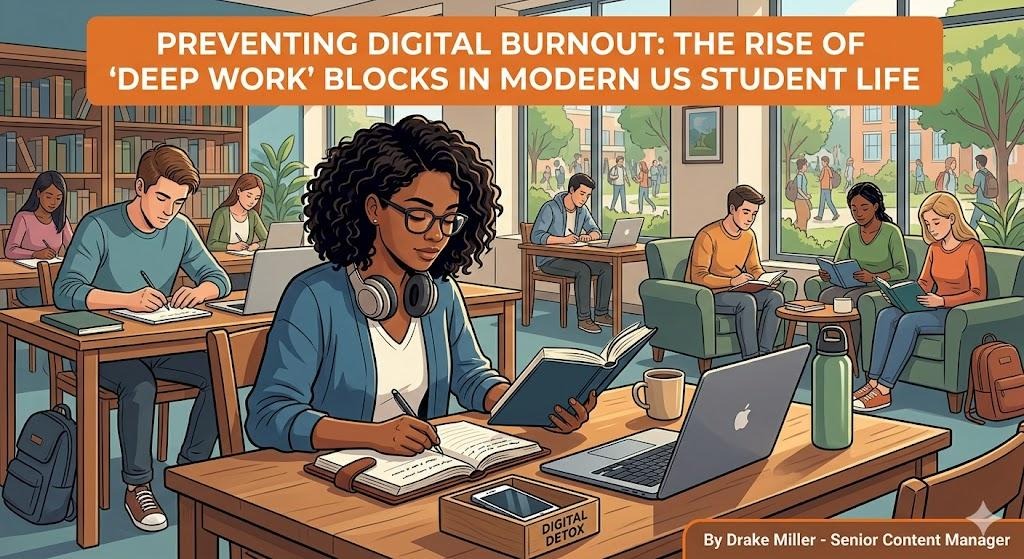
- The Phone Cemetery: Designate a spot (a drawer or a different room) where your phone “goes to die” during study blocks.
- Analog Tools: Sometimes, the best way to plan a complex essay or solve a calculus problem is with a physical notebook and a pen, away from the blue light of a screen.
3. Scheduling “Shallow Work”
Not all tasks require deep focus. Responding to emails, formatting a bibliography, or checking grades is “shallow work.” The mistake most students make is mixing shallow and deep work. By batching shallow tasks into a specific 30-minute window in the afternoon, you protect your peak morning or evening hours for high-intensity cognitive labor.
The Role of Academic Support in Reducing Burnout
One of the primary drivers of digital burnout is the sheer volume of work combined with “cognitive bottlenecks”—those moments when you hit a wall and don’t know how to proceed. When a student feels overwhelmed by a 2,000-word research paper or a complex programming project, the “freeze” response kicks in, leading to hours of mindless scrolling as a form of avoidance.
This is where strategic academic assistance becomes a vital tool for mental health. Utilizing professional resources can help students break down massive projects into manageable parts. For instance, when technical bottlenecks like complex R-programming or nuanced literature reviews stall a Deep Work block, seeking a model paper or expert guidance from Myassignmenthelp can prevent the “procrastination loop.”
By clearing the path through expert clarification, students can maintain their focus without the paralyzing fear of “not knowing where to start.” This allows them to delegate the stress of structural hurdles and focus their “Deep Work” energy on actual learning and mastery.
The Psychological Benefits of Depth
Beyond better grades, Deep Work offers a profound psychological benefit: The Flow State.
Psychologist Mihaly Csikszentmihalyi described “flow” as a state where a person is so involved in an activity that nothing else seems to matter. When students achieve flow through Deep Work, their anxiety levels drop. The “noise” of social media comparison and the “hustle culture” of US high schools fades away. They finish their day with a sense of efficacy and pride, rather than the hollow exhaustion that comes from a day of multitasking.
Combating the “Social FOMO”
The biggest hurdle for US students is the Fear Of Missing Out (FOMO). If you aren’t on the group chat for two hours, will you miss a plan? Will you be out of the loop?
The Rise of Deep Work blocks has led to a counter-culture: JOMO (The Joy Of Missing Out). Top-performing students are realizing that being “unavailable” is a superpower. By setting boundaries—such as “Do Not Disturb” modes that notify contacts you are focusing—students are training their social circles to respect their deep focus time. In 2026, the most successful students aren’t the ones who respond fastest, but the ones who produce the deepest work.
Frequently Asked Questions
Q.1 How do I start Deep Work if I have a short attention span?
Start with “Focus Sprints.” Set a timer for just 20 minutes of total isolation. Gradually increase this by 5 minutes every few days until you can reach a 90-minute Deep Work block.
Q.2 Is Deep Work better than the Pomodoro Technique?
They can work together! Use the Pomodoro Technique (25 mins work / 5 mins break) for shallow work. For Deep Work, however, you generally need longer blocks (60-90 mins) to enter a true “flow state” without the interruption of a timer.
Q.3 What are the first signs of digital burnout in students?
Common signs include irritability when away from devices, “brain fog,” difficulty concentrating on a single page of text, and feeling exhausted even after a full night’s sleep.
Q.4 How can Myassignmenthelp assist with burnout?
By providing model assignments, the service helps remove the “mental block” of difficult topics, allowing you to focus your limited energy on high-value learning rather than getting stuck on minor technicalities.
Conclusion: The Future of Focused Education
The “Rise of Deep Work” is more than a trend; it is a necessary evolution in the face of an increasingly distracting digital landscape. For the American student navigating the 2026 academic year, the ability to focus is the ultimate competitive advantage.
By embracing Deep Work blocks, you aren’t just protecting your GPA—you are protecting your mental well-being and reclaiming your time in a world that is constantly trying to steal it. Depth is where the learning happens, and more importantly, it is where the burnout ends.
About the Author
Drake Miller is a Senior Content Strategist and Academic Consultant specializing in student productivity and digital wellness. With over a decade of experience in higher education strategy, Drake focuses on the intersection of cognitive science and modern study habits. He is a frequent contributor to educational forums across the US and UK, advocating for “Skills-First” learning and ethical AI-human collaboration in the classroom. When he isn’t drafting deep-dive guides for students, Drake can be found researching the latest trends in digital minimalism or cheering for Arsenal FC.